

We are overthinking AI chat history — just like Chrome did with web history.
Nearly 20 years ago, Google’s Chrome team built a full index of every web page every user ever visited. This created an incredibly rich dataset. Designers imagined that with the right interface, users could rediscover the web, gain insights about themselves, and even visualize their own digital journeys.
But in the end, the best UI for history was profoundly simple.
Designing web history
In 2008, web history existed in every browser but was rarely used. Chrome’s team believed it could be much more — a personalized dataset that helped people re-find content and even understand their own browsing patterns.
Designers dove in, sketching wildly different interfaces from personalized subway maps, to data digests, to Google Reader-style feeds, and more.
I spoke with Chrome’s first designer, Glen Murphy, a while back about the team’s vision and their hard bump into reality:
“We kept every web page you ever visited, like a full text index. So you could search everything. History was going to be this amazing thing. Once a user could access their whole history, it would unlock so many insights.
But in the end, it didn’t matter. No one used history. They just went back to Google and searched for what they were looking for again.”
— Glen Murphy
Of course.
People didn’t want a fancy UI to comb back through their history and glean insights about themselves as navigators of the internet. They just wanted to find that article they were reading the other day or the pumpkin pie recipe they made last fall. And just searching again was easier.
Indexing history wasn’t wrong. Quite the opposite. But history didn’t need to be a stand-out feature. It could quietly power search suggestions, surface shortcuts, and be available for the few times someone really needed to retrace their steps.
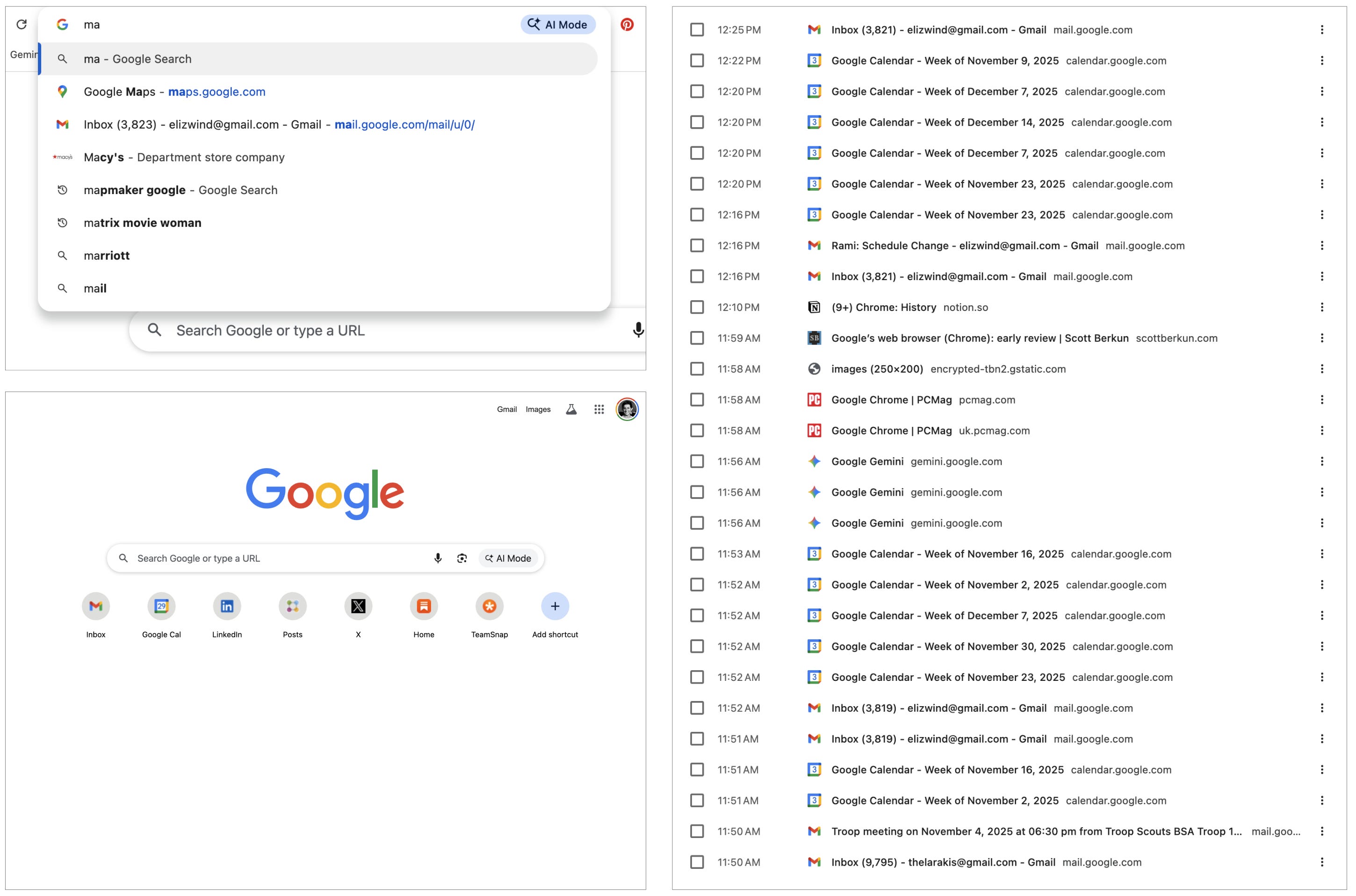
When Chrome launched, its personalized start page reflected this. It showed your most visited web pages, recent searches, bookmarks, and recently closed tabs. If you wanted more, the full history lived behind the understated “Command + Y.”

These product fundamentals were solid from the beginning. Over time, Chrome’s history UI has evolved only slightly, mostly just modernizing its aesthetics.
LLMs + History
Today, AI teams are replaying these same conversations that Chrome once had. In fact, some of the same people are in the room (like Ben Goodger, who helped build Chrome and now leads engineering for Atlas at OpenAI).
User history in LLMs will likely play out much as it did for web history. While powerful and full of potential, most people won’t view chat history as a destination. Instead, it will quietly power features that make the product smarter, more personalized, and more efficient.
Users will always take the path of least resistance. Follow that path and make it better. Like web search, it’s often easier to just start a new chat. And that’s OK. Design for it. Consider what is actually useful for people to come back to versus what should be noted behind the scenes.
Based on these principles, here are a few AI-specific design ideas:
Design chats to be disposable. Normalize starting fresh. Don’t burden people with the cognitive overhead of understanding how the model handles history.
Surface what gets reused. If a user revisits specific chats, make those more prominent in the UI (like Chrome’s most visited pages).
Add lightweight memory. Let people bookmark chats or snippets of chats that they may want to revisit.
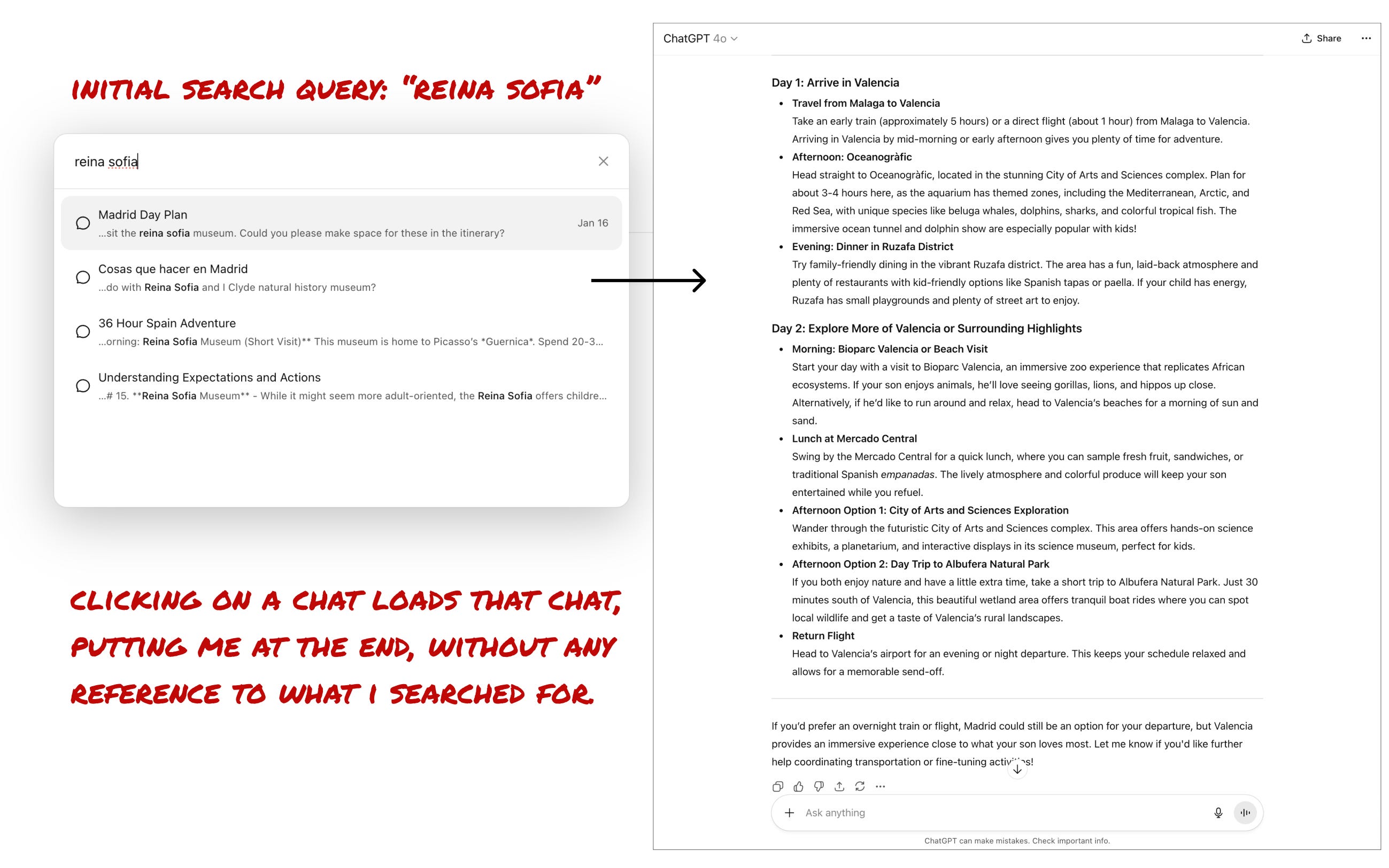
Make search meaningful. When people look for something, take them to the answer, don’t just dump them at the end of a chat that contains the keywords they searched for. Highlight the relevant phrase or passage for faster scanning. There are lots of existing patterns to borrow.
The Complexity of LLM Memory
Of course, the simplicity we want users to experience hides a complex memory architecture beneath. There are multiple layers of memory: short-term “working memory” within a chat, long-term memory across sessions, persistent personal memory, and retrieval systems that pull from stored knowledge.
Each model also works differently. Claude has robust short-term memory within a session, but starts fresh with each new chat. ChatGPT retains less within a single conversation but remembers “key facts” and preferences across sessions. Gemini can process extremely large prompts and integrate context from other Google properties, but doesn’t yet build persistent personal memory.
These differences make it hard to design consistent mental models. But the more products can shift this complexity off users and just present a simple, coherent model for history, the better.
By contrast, users never needed to understand the nuances of how Google Chrome handled history behind the scenes. It just worked. Chrome’s model for history felt simple and sensible:
Transparent history: Every page you visit is logged and viewable in reverse-chronological order with dates and timestamps.
Value add: Chrome uses that data to suggest and shortcut to your most-visited sites.
Bookmarks: You can save what matters. Bookmarks surface in search results and are findable in bookmarks.
Opt-out: If you don’t want something saved, incognito mode is one click away.
The future of LLM History
The big lesson here is to keep it simple, coherent, and invisible when possible. Not all features need a UI, and many thrive with a minimal one.
AI teams should treat user history as powerful infrastructure, not a user-facing feature. It’s a background dataset that can supercharge personalization, context, and recall across the core product.
The Chrome team took these learnings to heart, focused their efforts on core product features, and wove history in where it made sense.
“At the end of the day, we realized getting the fundamentals of the UI right was super important. If you’ve got an extra month, it’s better to improve the core UI by 1 % than to improve this whole other section of the product that no one ever uses by like a hundred percent.”
— Glen Murphy
History’s job isn’t to be remembered, it’s to make everything else smoother. The best designs let history live in the background, weaving it into the experience when it makes sense, and propelling users forward.
Great post! Just a little brain niggle. What about odd ones out like me who return to the same chats to continue the story or the search or the research? I do this all of the time - and need to. I don't like starting over - even if the LLMs have memory. The memory isn't perfect yet.
Referring to:
Design chats to be disposable. Normalize starting fresh. Don’t burden people with the cognitive overhead of understanding how the model handles history.
Thanks, Elizabeth!
Thanks. Here via Ben's Bites